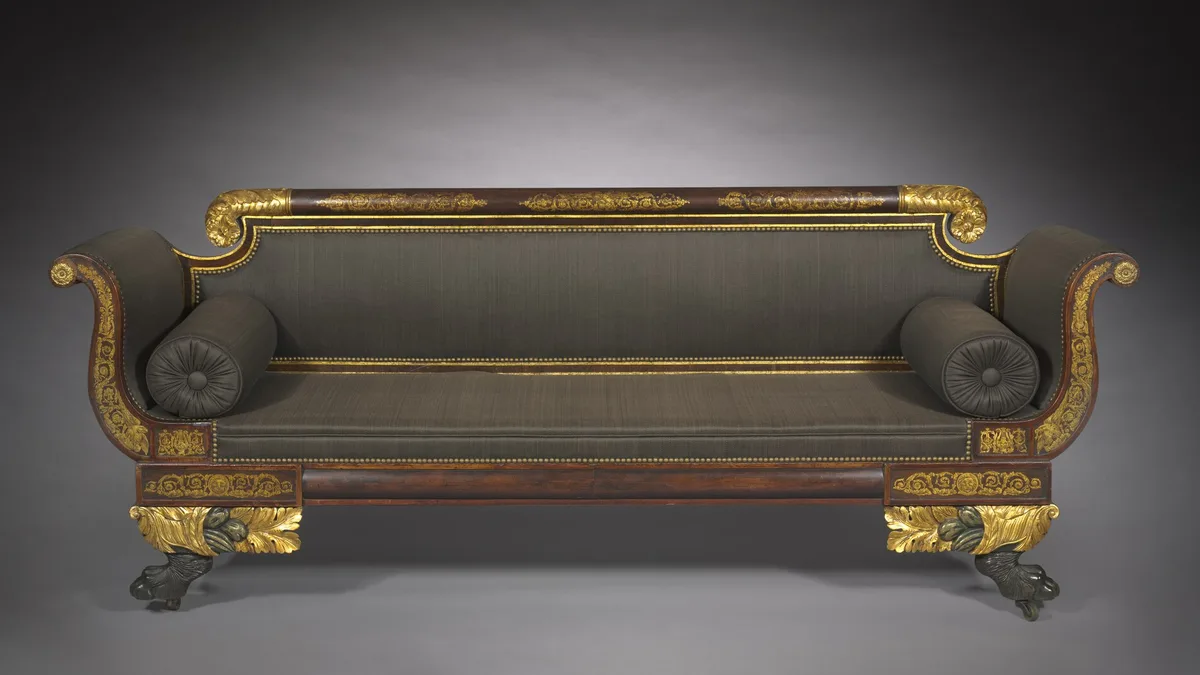
Sofa
| Country of origin | Varies by specific design |
|---|---|
| First created | 17th century |
| Original use | Long, upholstered seat for reclining |
| Frame material | Hardwood, engineered wood, or metal |
| Joinery method | Mortise and tenon, dowels, corner blocks, or metal brackets |
| Cushion fill | Foam, feathers, down, or fiber |
| Upholstery material | Fabric, leather, or synthetic |
| Seating capacity | Typically two to four persons |
Origin and history
The sofa, as a padded seat for multiple people, originated in the formal reception rooms of late 17th century France and England. Its direct predecessor is the French "canapé," a derivative of the daybed, which itself evolved from ancient Roman and Egyptian reclining couches. The key development was the move from a single-person couch to a specifically social seat designed for conversation among the aristocracy. The term "sofa" entered English from the Arabic "ṣuffah," referring to a raised, long bench, through Turkish influences in the early 18th century. Early versions were often ornately carved from wood and upholstered in expensive fabrics, signifying status and wealth. The industrial revolution of the 19th century enabled mass production, making sofa ownership common in middle-class homes and solidifying its role as a central domestic furniture piece.
What it is for
A sofa is a long, upholstered seat with a back and arms, designed to accommodate multiple people simultaneously for seated activities. Its primary function is to provide a comfortable, shared seating platform in living rooms, lounges, and reception areas, facilitating social interaction and group relaxation. Beyond seating, it often serves as a focal point for room arrangement and defines a conversational area within a larger space. Many sofas are also designed for reclining or napping, with some models incorporating mechanisms to extend into a bed for occasional guest use. The piece supports a range of activities from reading and watching television to formal entertaining. Its construction must therefore balance immediate comfort with long-term durability to withstand regular use and the weight of several occupants.
Pros and cons
A well-constructed sofa provides durable, comfortable seating for years and becomes a central, functional asset in a household. The primary pro is its capacity for communal use, offering a shared space that encourages social interaction unlike individual chairs. However, a significant con is its substantial spatial footprint, often dominating a room and making it unsuitable for small living areas. Many buyers regret choosing a sofa based solely on styling or temporary comfort, neglecting the joinery and frame materials, which leads to premature sagging, wobbling, or joint failure. A common mistake is prioritizing a deep, plush seat cushion without considering support, resulting in a sofa that is difficult to sit upright in and becomes uncomfortable for extended periods. Low-quality sofas with stapled or glued joints frequently fail at the stress points where the arms meet the seat frame, requiring costly repair or replacement long before the fabric wears out.
Who it suits
This furniture type suits households and spaces where communal seating is a regular requirement, such as family living rooms or common areas in shared accommodations. It is particularly suited to individuals who entertain guests frequently, as it provides ample, inviting seating for groups. People with larger living spaces benefit most, as a sofa can anchor a room without overwhelming it. Those who prioritize long-term value and durability over initial cost should seek out sofas with proven joinery techniques like double-doweled frames or mortise-and-tenon joints. It is less suited for transient living situations or very small studios, where its size becomes a hindrance, and individual chairs or a modular sectional may offer greater flexibility. Ultimately, it suits the buyer who understands its construction as a long-term investment in daily use, not merely a decorative purchase.