Paul Sellers on Bench Plane Grip
Paul Sellers discusses the subtle, apprentice-learned techniques of gripping and using a bench plane, skills not found in manuals or from power tool use.
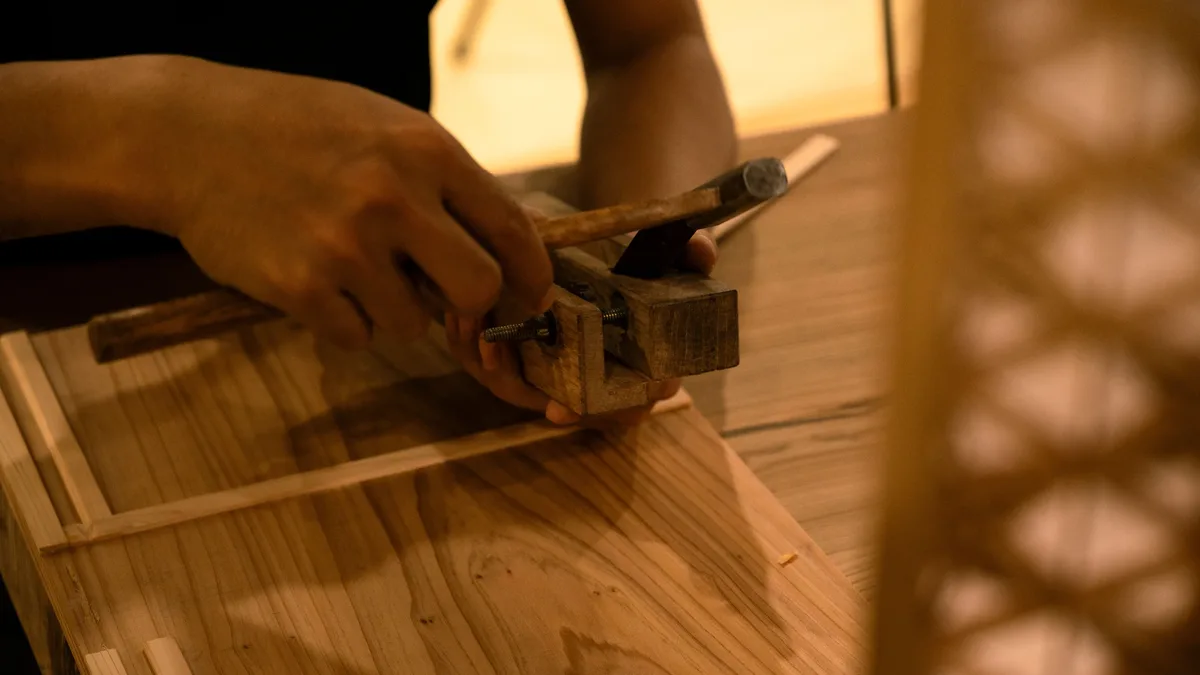
Paul Sellers argues that most woodworkers do not truly understand how to grip and handle a bench plane. He bases this on decades of hand-tool experience, contrasting it with the 'viselike bulldogging grip' he associates with carpenters using power tools.
Sellers learned these subtleties as a fifteen-year-old novice under the guidance of George, a man in his mid-twenties at the time. George's corrections, often communicated through a cough or a throat-clearing, taught Sellers that effective planing is about constant, subtle adjustment, not brute force. The instruction to 'get a grip' was about finesse, not strength.
The Unspoken Language of the Bench
True mastery of hand planes, according to Sellers, comes from apprenticeship with an experienced maker, not from academic study. He states that his own hand hold may change fifty times in the pursuit of a smooth surface. These micro-adjustments include slight skews, balancing pressure, and minimal circular motions that majorly change the planing dynamic.
He encourages experimentation, even on active projects, to build a repertoire of techniques for future mastery. Sellers recalls being criticized for planing across the grain on a wide board, but he asserts that with complex wood grain, the right technique is the one that yields the desired result, which might be one out of fifty possible approaches.
Defying Conventional Wisdom
Sellers notes that old instructional books rarely showed versatile hand holds, only rigid ones, offering little value to novices. He learned from George to plane the end grain of dovetail pins using cross-grain strokes and circular motions, techniques that defied conventional texts.
He points out a scarcity of experienced makers discussing alternative techniques. Furthermore, he estimates that perhaps only one percent of experienced makers use hand tools for any significant time daily, a reality he believes holds back skill development.
Hand Tools for Specific Tasks
Sellers is definitive about his tool choices for specific tasks. He would never use a power router to rout for a hinge flap, nor would he level dovetail pins or tails with a belt sander or power planer. He finds these methods unnecessarily complicated for his non-mass-production work, preferring a sharp plane and select techniques to finish the job quickly.
He has no issue with using a random orbit sander or belt sander for finishing. He states that a random orbit sander with a newish 280-grit disc can leave the smoothest finish. Its advantage is that it removes only a small amount of material, thus preserving the flatness achieved by planing. However, he cautions that progressing through multiple grits from coarse to fine can create problems on fine work.